

Tether Wallet
Hardware signer for Tether WDK
A fork of Tether’s own wallet app, rebuilt so Passport holds the account key, re-parses every transaction, and signs over QuantumLink only after you approve on-screen.
Last updated Aug 2026
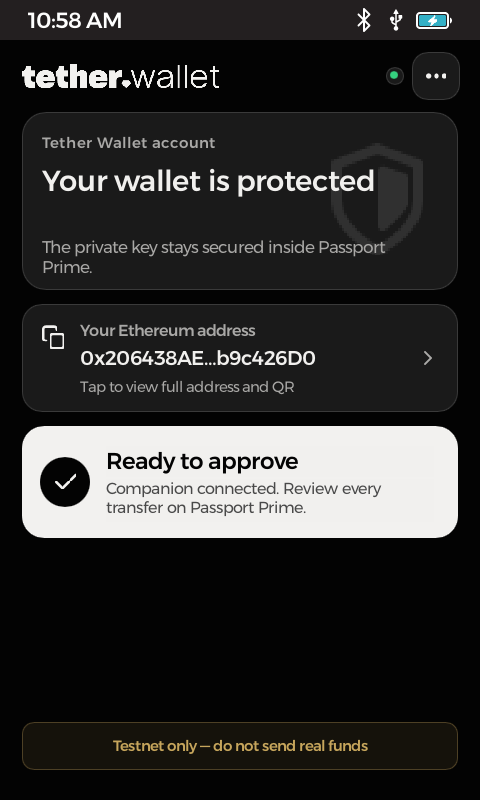
Wallet home · key held on Passport
Overview
A fork of Tether’s existing wallet app, wired to Passport as an external signer. The Android side keeps the real Tether Wallet experience, built on Tether’s Wallet Development Kit (WDK): the same home, activity, and receive screens, the same asset and network sheets, and WDK’s own EVM and Bitcoin wallet libraries for balances, coin selection, fee estimation, and broadcast. What changes is where the key lives. The phone holds no seed, and Passport holds the account key and signs.
The two halves talk over QuantumLink, Passport’s authenticated encrypted Bluetooth transport. The phone builds a canonical EIP-1559 transaction or a PSBT and hands it over as a request; Passport derives the account key, re-parses the transaction independently, checks it against policy, renders the authoritative review, and returns a signature only after an approval gesture. The phone is treated as untrusted input throughout, so the review screen on the device is a second opinion rather than an echo of what the phone believes it is sending.
What it does
- A fork of Tether’s own wallet app, keeping its screens, asset and network sheets, and WDK wallet libraries intact.
- Plugs into WDK as an external signer: the phone holds no seed and the signer never exposes a private key.
- Standard derivation paths, m/44’/60’/0’/0/0 for EVM and m/84’/1’/0’/0/0 for Bitcoin, from an app-specific key on the device.
- Signs canonical EIP-1559 transactions for Ethereum and PSBTs for Bitcoin.
- On-device policy checks for chain, destination, calldata, fees, value, transaction type, and request replay.
- QuantumLink over BLE with authenticated sessions, replay protection, peer identity pinning, reconnect, and two-sided unpairing.
- Pairing by static Bluetooth QR followed by an animated identity QR.
- The phone verifies the signed transaction matches its request, and recovers to the Passport-derived address, before broadcasting.
See it in action
Technical breakdown
How the app is built, for developers evaluating the platform.
A fork of the real Tether wallet
The Android companion is a fork of Tether’s existing wallet app rather than a lookalike. It keeps the production screens and Tether’s Wallet Development Kit underneath: the WDK EVM and Bitcoin wallet libraries handle balances, coin selection, fee estimation, and broadcast, and the React Native UI kit supplies the interface. The fork swaps the local key for Passport through WDK’s external-signer interface, which is the seam WDK already exposes for hardware.
Phone builds, Passport decides
The phone assembles a canonical EIP-1559 transaction for Ethereum or a PSBT for Bitcoin and sends it as a request over an authenticated QuantumLink session. Passport re-parses and validates every security-relevant field before presenting the review, signs, and returns the result. The phone then checks the signed transaction matches what it asked for, and that it recovers to the Passport-derived address, before broadcasting.
Independent parsing on the device
WDK runs only on the phone. The Passport app shares no code with it and re-implements transaction parsing from scratch against the underlying standards, so what you approve on the device screen is derived from the raw transaction rather than from the phone’s own interpretation of it. Policy checks cover chain, destination, calldata, fees, value, transaction type, and request replay.
Dig into the source
README, architecture notes, and the wire protocol live in the repo.